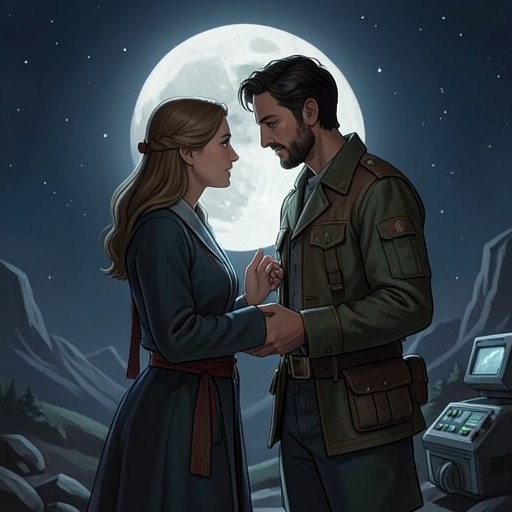
Tomorrow Tomorrow.
The God of Small Things“Tomorrow? Tomorrow.” is the brief promise Ammu and Velutha make when they part, a refrain that gives their forbidden love its smallest imaginable future. The question and its answer are not a plan or a rescue: both know they have nowhere to go and nothing ahead of them. Their repeated exchange therefore carries hope and its limit at once, as the promise of another day persists inside a story in which things can change in a day—and do.
A promise made at parting
Each time they separate, Ammu and Velutha extract just one small promise from each other: “Tomorrow?” “Tomorrow.” The exchange reduces the future to a single word, offered not as certainty but as something they can ask and answer together. Its repetition gives their meetings a fragile rhythm: parting brings the question, and the reply briefly keeps the next day imaginable.
The promise belongs to a relationship hemmed in by circumstances neither lover can transform through speech. The narration makes clear that they know there is nowhere for them to go and that they have no future. Against that knowledge, “Tomorrow” does not cancel the danger or furnish an escape. It names the small interval they can still hold between one separation and the next.
Small Things and the life they make
In the thirteen nights that follow, Ammu and Velutha instinctively stick to the Small Things; the Big Things remain hidden inside. Their attention settles on minute, observable life: ant-bites, clumsy caterpillars sliding from leaves, overturned beetles, and two small fish that seek Velutha in the river and bite him. They laugh, too, at a particularly devout praying mantis and at the spider living in a crack in the back verandah wall of the History House.
The spider’s camouflage is made from scraps—a sliver of wasp wing, part of a cobweb, dust, leaf rot, and the empty thorax of a dead bee. Velutha calls it Chappa Thamburan, Lord Rubbish. The creatures’ precarious persistence becomes more than a diversion: the lovers link their fates and hopes, without admitting it to each other or themselves, to this fragile life. They check on the spider each night, increasingly anxious that it might not have survived the day; they worry about its smallness and camouflage, and come to love its eclectic taste and shambling dignity. They choose it because they know they must put their faith in fragility—must stick to Smallness.
Repetition, hope, and the sudden day
The refrain’s force depends on its return. The lovers do not ask for a grand promise; they ask only whether there will be a tomorrow, and answer each other with the same word. In this pattern, repetition makes a modest form of continuity possible even when the relationship has no recognized or secure future. The question remains open each time it is asked, while the answer briefly makes continued closeness conceivable.
Yet the narration places that daily hope beside a warning: Ammu and Velutha know that things can change in a day, and they are right. “Tomorrow” cannot guarantee what the next day will bring. The future the refrain evokes is real as a desire and as an exchange between them, but the story’s abrupt reversals make it no promise of safety. Its tenderness comes from that imbalance: the lovers repeat a word of hope while knowing how little control they have over what follows.
Ammu’s final word
At their parting, Ammu kisses Velutha’s closed eyes and stands. He watches her walk away with his back against the mangosteen tree; she has a dry rose in her hair. She turns to say it once again: “Naaley.” The word is followed by its translation, “Tomorrow.” The ending returns the refrain to its simplest form, but now the scene’s gesture and separation give the answer a particular weight. It renews their small promise without changing the conditions that make it fragile.
Across the thirteen nights, the repeated question and answer have served as a thread binding the lovers’ encounters to the small life around them. At the final parting, the thread remains: Ammu speaks the word again, and Velutha stays watching as she leaves. “Tomorrow? Tomorrow.” thus expresses neither a fulfilled future nor a durable guarantee. It preserves, for a moment, the only hope they can ask of each other.